
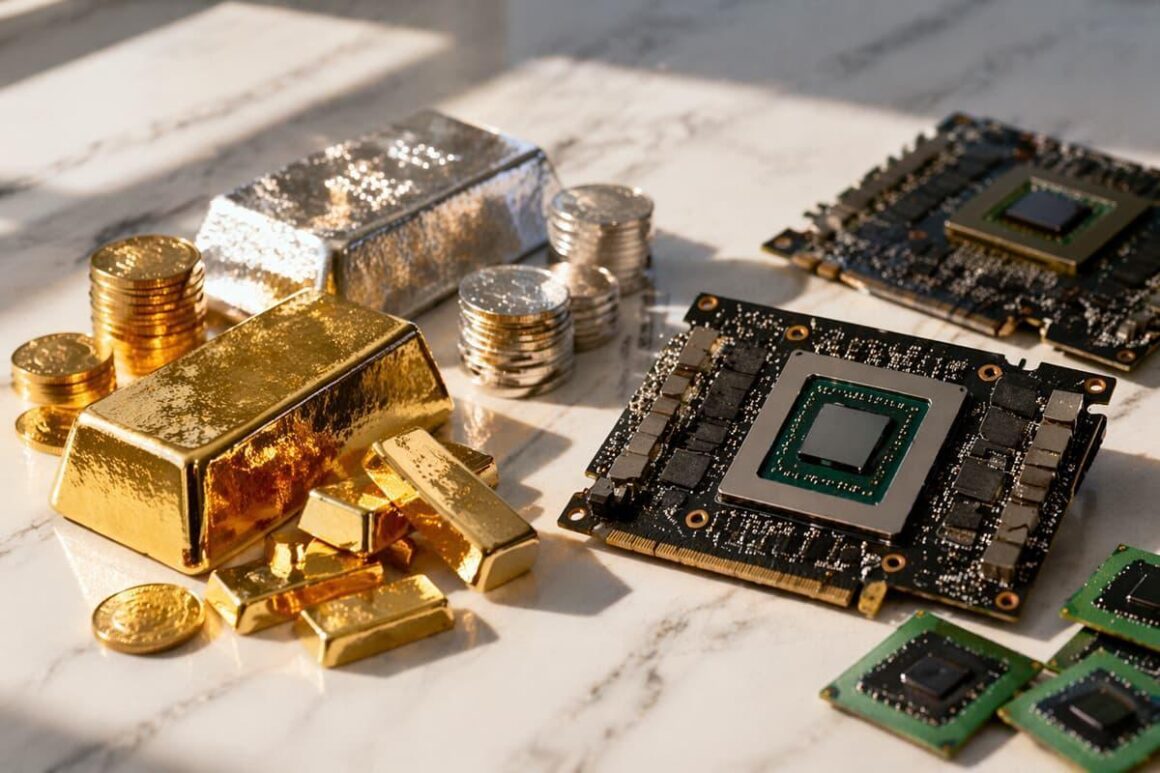
Artificial intelligence is increasingly being used to analyze financial markets, including precious metals. This article explores whether AI can truly predict where prices for assets like gold and silver are heading.
How AI Approaches Market Analysis
At its core, AI looks for patterns in large amounts of data. In the context of precious metals, that includes historical prices, macroeconomic indicators, currency movements, interest rates, and even geopolitical events. Tools that generate a silver price forecast often rely on machine learning models trained on years of market behavior, attempting to identify signals that human analysts might miss.
Unlike traditional models, AI can process multiple variables at once and adjust its assumptions as new data comes in. For example, if inflation data suddenly shifts or central banks change policy direction, AI systems can quickly factor that into updated projections. This flexibility is one of the main reasons investors are paying attention to AI-driven insights.
However, recognizing patterns is not the same as understanding causes. AI does not “know” why gold rises during uncertainty or why silver reacts to industrial demand. It simply identifies correlations. That distinction matters when markets behave in unexpected ways.
What Makes Precious Metals Hard to Predict
Precious metals are influenced by a unique mix of factors. Gold is often seen as a safe haven, meaning its price can rise during economic uncertainty or market stress. Silver, on the other hand, has both investment and industrial demand, which makes it more complex.
AI models must account for variables such as inflation expectations, real interest rates, currency strength, and global demand trends. On top of that, sudden geopolitical events can disrupt even the most well-structured models. A conflict, a trade dispute, or a central bank announcement can move prices in ways that are difficult to anticipate.
Another challenge is market sentiment. Human behavior plays a significant role in price movements, especially in times of fear or optimism. While AI can analyze sentiment through news and social media, it is still difficult to fully capture how investors will react in real time.
Where AI Performs Well
AI tends to perform best in stable environments where patterns repeat over time. In such conditions, it can identify trends and provide useful guidance. For example, if gold has historically reacted in a certain way to declining real interest rates, AI can detect that relationship and incorporate it into its projections.
Short-term trading is another area where AI can add value. High-frequency trading systems already use algorithms to exploit small price movements. These systems rely on speed and data processing rather than long-term predictions.
AI is also useful for scenario analysis. Instead of trying to predict a single outcome, it can model multiple possibilities. For instance, it can estimate how gold might behave if inflation rises faster than expected, or if the dollar weakens significantly. This approach helps investors prepare rather than rely on one forecast.
The Limits of AI Predictions
Despite its capabilities, AI has clear limitations. One major issue is overfitting, where a model becomes too closely tied to past data and fails to adapt to new conditions. Markets evolve, and relationships that worked in the past may not hold in the future.
Another limitation is data quality. AI models are only as good as the data they receive. If the data is incomplete, outdated, or biased, the predictions will reflect those flaws. This is especially relevant in global markets, where data can vary in reliability.
There is also the problem of unexpected events. AI struggles with what are often called “black swan” events. These are rare but impactful occurrences that fall outside normal patterns. Precious metals, particularly gold, often react strongly to such events, which makes prediction even more challenging.
So, Can AI Really Predict Prices?
The short answer is that AI can help, but it cannot guarantee accurate predictions. It is a tool, not a crystal ball. It can highlight trends, identify relationships, and improve decision-making, but it does not eliminate uncertainty.
For investors, the most practical approach is to use AI as part of a broader strategy. Combining AI insights with fundamental analysis and market experience tends to produce better results than relying on any single method.
In the end, precious metal prices are shaped by a mix of data, human behavior, and unpredictable events. AI can make sense of some of that complexity, but it cannot fully control or predict it. The future of gold and silver will likely remain a mix of patterns and surprises, with AI playing a growing but still limited role in understanding both.